The first year of vision development
From learning to focus and following movement — here are the vision milestones to watch for in your baby and signs it’s time for an eye exam.
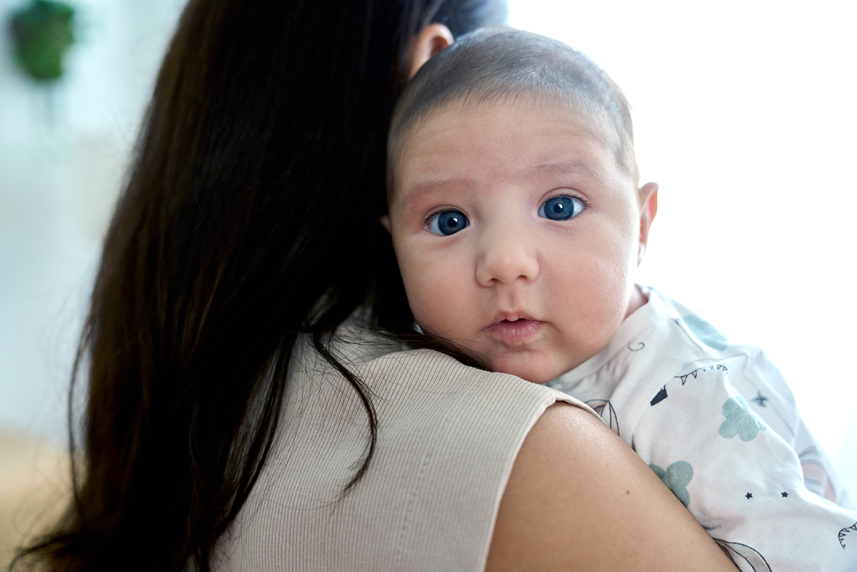
A baby's vision develops quickly during the first 12 months of life. What starts as blurry, limited sight slowly becomes clear and well-coordinated. Parents often wonder what a baby can see and when things will change. Knowing what is typical can make these early months easier to understand. Here is a look at how vision grows from birth to the first birthday.
Birth to 1 month
Newborn vision is blurry at first. They can only see clearly up close — usually at about 8 to 12 inches.1 That is about the space between a baby's face and a parent's face during a feeding.
At this age, babies see mostly black, white and shades of gray. Bold patterns and high-contrast shapes catch their attention. Faces are a favorite too.
It is also common for a newborn's eyes to look like they wander or cross now and then. The eye muscles are still weak and learning to work together.2 This usually improves within the first few months.
Eye care providers in the UnitedHealthcare Vision Network can keep people of all ages’ vision healthy. Search for network providers now.
2 to 3 months
By 2 months, babies begin to look at faces for longer stretches. Many smile back at a familiar face around this time. By 3 months, most babies start to follow a moving object with their eyes.3
A simple way to see this skill grow is to slowly move a toy from side to side in front of the little one. At first, the eyes may jerk or lose track of the toy. Over time, the movement becomes smoother.
Babies also start to stare at their own hands and bat at things that hang within reach. Eye crossing should happen less and less during these months. Both eyes should begin to look in the same direction most of the time.
Looking to go glasses- and contacts-free?
LASIK surgery can help make it happen. UnitedHealthcare members get up to 35% off laser vision correction services.
4 to 5 Months
Color vision takes a big step forward at this age. Babies can tell many colors apart.4 Bright colors such as red and yellow are often the easiest for them to notice. This is one reason colorful toys hold a baby's attention so well.
Depth perception also begins to grow.4 This means seeing how far away an object is. It happens when both eyes send a picture to the brain and the brain blends the two into one. Strong teamwork between the eyes makes this possible.
As depth perception improves, babies get better at reaching for things. A baby who once swatted at a toy and missed may now grab it with ease.
Looking for a new eye care provider? Search the UnitedHealthcare Vision Network today.
6 to 8 Months
Between 6 and 8 months, vision becomes sharper and more useful. Babies can see farther across a room. They may recognize a familiar face from a distance and react with a smile or a wave.
Eyes and hands work together better now.4 Passing a toy from one hand to the other is a common sign of the eyes working together. Babies also watch people and pets move around the room with great interest. Depth perception keeps getting stronger, which helps with rolling and sitting up.
9 to 12 Months
By this stage, many babies are starting to crawl and pulling themselves up to stand.5 This milestone helps them learn about distance. They can figure out how far away a couch is or how high a step might be.
At 12 months, many babies can spot tiny objects such as a crumb on the floor and pick it up with two fingers. They can also follow fast-moving objects and look for a toy that has been hidden.
Vision is still not fully grown at the first birthday. Sharpness continues to improve through early childhood. But the basic skills for seeing the world are in place.
When to schedule an eye exam
A baby's vision is checked at regular well-baby visits with a pediatrician. Many experts also suggest the first comprehensive eye exam between 6 and 12 months of age.4 This exam is quick and gentle.
An exam may be needed sooner if any of these signs appear:
- Eyes that turn in or out often after 4 months of age
- Eyes that do not follow objects by 3 months
- Constant tearing or watery eyes
- Red, swollen or crusty eyelids
- A white or gray look in the pupil
- Strong sensitivity to light
A baby who was born early or has a family history of eye problems may also need an earlier visit. A pediatrician can help decide the best timing.
What to expect over time
The first year brings big changes in how a baby sees the world. Blurry shapes become clear faces. Simple movements turn into smooth tracking and careful reaching. Parents who know what is typical can enjoy each stage and spot anything that seems unusual. When in doubt, a quick call to a pediatrician or eye care provider can bring peace of mind and help protect a baby's healthy vision.
Sources
- Your Newborn's Hearing, Vision, and Other Senses Nemours KidsHealth, accessed September 20, 2026
- Strabismus Nemours KidsHealth, November 2022
- Infant development: Birth to 3 months Mayo Clinic, March 13, 2025
- Infant vision: Birth to 24 months of age American Optometric Association, accessed September 20, 2026
- When will your baby start walking? Cleveland Clinic, September 19, 2024